What Does the Inside of an Air Ambulance Look Like?
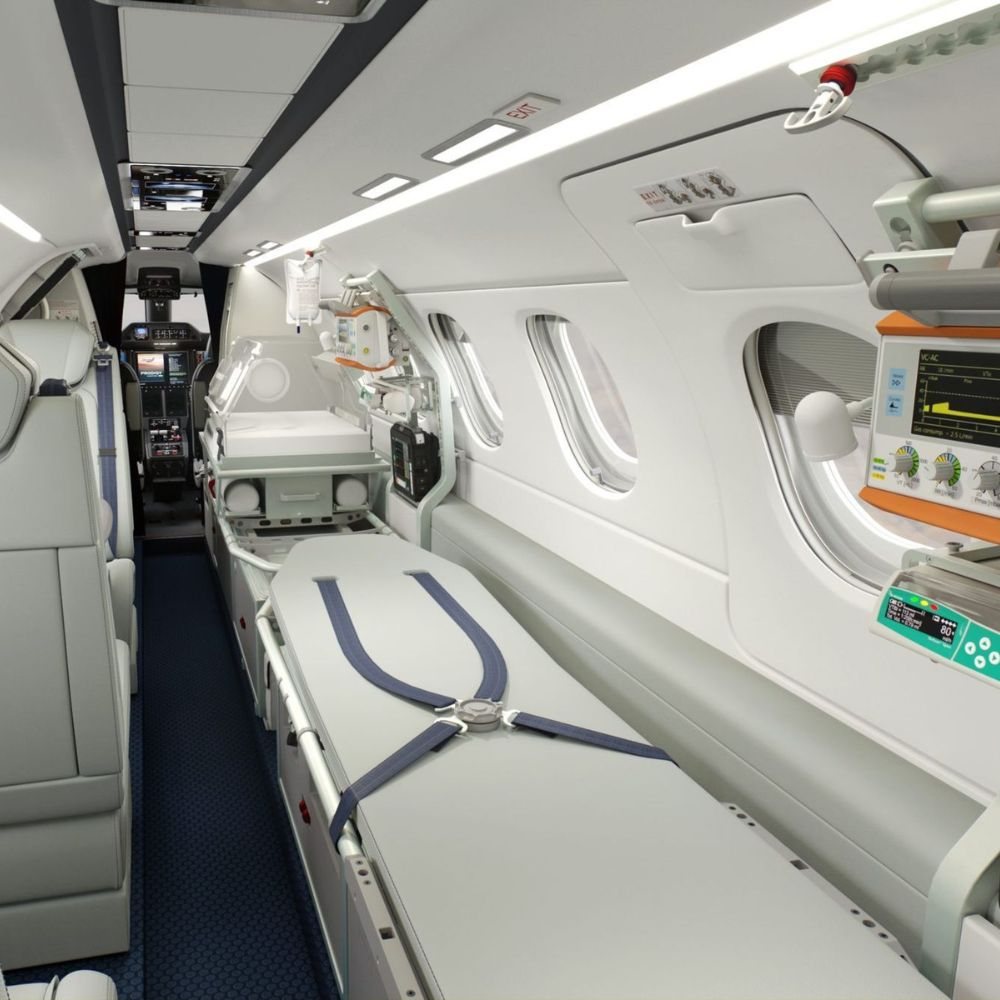
A small intensive-care room that flies
From the outside, an air ambulance looks like a business jet or a turboprop. Inside, the cabin has been converted to receive a patient and a medical team. The layout is designed so that the team can reach the patient from several sides, watch the monitors at all times, and treat the patient in flight if needed.
The stretcher
The patient lies on a stretcher fixed to the floor of the cabin with a certified attachment system. It can generally be tilted, and the patient is secured with belts. The stretcher is loaded through the cabin door, often with a loading system that avoids lifting the patient by hand. Some aircraft can carry two stretchers, for two patients or for a patient and an incubator.
Monitoring equipment
A transport monitor follows the patient's vital signs: heart rhythm, blood pressure, oxygen saturation and, if necessary, other parameters. The screen is placed where the physician and the nurse can see it from their seats, and alarms warn the team of any change. This is the same kind of equipment as in an ambulance or an intensive-care unit, adapted for transport.
Oxygen and respiratory support
Oxygen is available throughout the flight, with reserve cylinders. For patients who cannot breathe alone, a transport ventilator, the same type as used in intensive care, is connected to the patient and set by the physician before departure. A suction device is within reach. Everything is secured so that it stays in place during take-off, turbulence and landing.
Infusion pumps and treatments
Syringe pumps and infusion pumps deliver treatments at a precise rate. They are fixed to the stretcher or to a support, and their batteries guarantee that they keep working during the loading and the transfers. The medical bag contains the emergency drugs and the consumables that the team may need.
Specific configurations
- Incubator for a newborn, with its own ventilator and monitoring, fixed to the stretcher support.
- Isolation stretcher for a patient with a contagious disease, to protect the crew.
- Intensive-care set-up with several pumps and a ventilator for the most severe patients.
- ECMO system in the cases where it is required, with a dedicated team.
The configuration is chosen by the coordinating physician after reading the medical file, and it determines which aircraft is used. See how to choose the right air ambulance aircraft.
Seats for the crew and for a relative
The physician and the nurse sit close to the stretcher, on seats that allow them to reach the patient. When a relative travels, a seat is provided a little further away, with a belt for take-off and landing. See who travels on board an air ambulance.
Temperature, light and noise
The cabin is air-conditioned and the temperature is adjusted to the patient's needs. The lighting allows the team to work at night, and the cabin pressure is controlled, which matters for some conditions. The noise level of a jet is lower than that of many people imagine, and the team can talk to the patient throughout the flight.
In short
- The cabin is arranged around a stretcher, a monitor, oxygen, a ventilator and infusion pumps.
- Configurations exist for newborns, isolation and intensive care.
- The physician and the nurse are seated close to the patient; a relative can sometimes travel further back.
- The aircraft and the layout are chosen for each patient by the coordinating physician.
To go further, read the difference between an air ambulance and a commercial flight with medical escort.
General information only — not personalized medical, legal or insurance advice. Your insurance contract and the treating physician's opinion prevail in your situation.
A medical situation abroad can't wait.
Our coordinators are available right now — every day, at any hour.