Who Travels on Board an Air Ambulance?
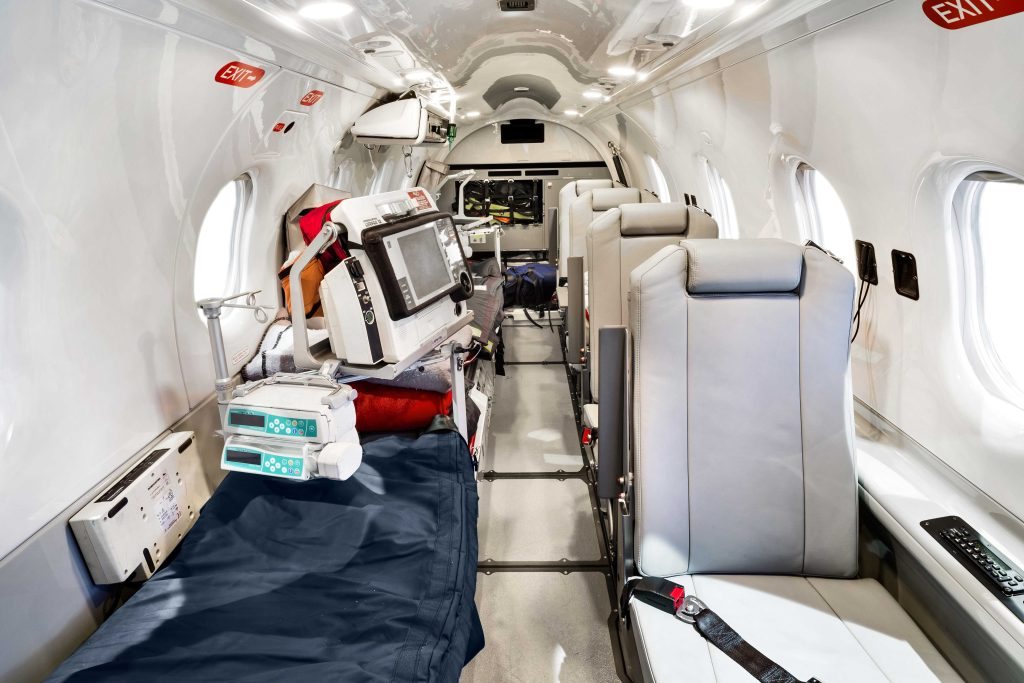
A team around one patient
An air ambulance is not just an aircraft with a stretcher. It is a team organized around one patient, in a cabin where every person has a role. Families often ask who will be with their relative during the flight and whether they can come along. Here is how it generally works.
The flight crew
Two pilots fly the aircraft. Their job is the safety of the flight: the route, the weather, the airports and the permits. They are trained for medical missions, and they work with the medical team on things that affect the patient, such as the choice of the flight level or the way the aircraft is handled on take-off and landing.
The physician
A physician is generally in charge of the patient during the flight, particularly when the condition is serious. The physician has read the medical file in advance, takes over the patient from the hospital team, decides on the treatment during the flight and hands the patient over to the receiving team. Depending on the case, this can be an emergency physician, an anesthesiologist or an intensive-care specialist.
The nurse
A nurse works with the physician. The nurse prepares and checks the equipment, monitors the patient, gives the treatments and keeps the flight record. In many missions, the physician and the nurse form the minimum medical team.
Specialist teams
When the condition requires it, the team is adapted:
- an intensive-care team for a ventilated or unstable patient;
- a pediatric or neonatal team for a child or a newborn, sometimes with an incubator;
- a team trained for ECMO or isolation in specific cases.
The composition of the team is decided by the coordinating physician after reading the file, and discussed with the treating physician and, when there is one, with the assistance company's doctors.
The medical coordination on the ground
Not everyone is on board. A coordinating physician and an operations team work on the ground, 24/7: they read the file, choose the aircraft and the crew, obtain the permits, arrange the ground ambulances and keep the family and the insurer informed. They are a part of the team even if they do not fly.
Can a relative travel with the patient?
In many cases, yes. A relative can often travel on a seat in the cabin, if the aircraft has a seat available and the patient's condition allows it. This depends on the aircraft, because the medical team and equipment take space, and on the medical team, who can decide that a relative should not be present in some situations. Some countries also ask for specific documents for the relative to enter. Ask when you request the quote, and give the relative's identity documents early.
What the relative can expect
- A briefing from the medical team before the flight.
- A seat away from the stretcher, with a safety belt for take-off and landing.
- A request to follow the crew's instructions, since the cabin is a medical space.
- Limited luggage, because of the space and the weight.
In short
- A minimum of two pilots and a medical team, often a physician and a nurse.
- The team is adapted to the patient: intensive care, pediatric, neonatal.
- A coordinating team works on the ground throughout.
- A relative can often travel, depending on the aircraft, the patient's condition and the documents.
To go further, read how to choose the right air ambulance aircraft and which documents to prepare for a medical repatriation.
General information only — not personalized medical, legal or insurance advice. Your insurance contract and the treating physician's opinion prevail in your situation.
A medical situation abroad can't wait.
Our coordinators are available right now — every day, at any hour.